'%20fill='%23D9D9D9'/%3e%3c/mask%3e%3cg%20mask='url(%23mask0_1192_3601)'%3e%3cpath%20d='M11.3062%2011.1824L7.04373%206.91992L5.3479%208.61576L11.3062%2014.5741L17.2646%208.61576L15.5687%206.91992L11.3062%2011.1824Z'%20fill='%23610064'/%3e%3c/g%3e%3c/svg%3e)

Completing a master's degree can help you build advanced technical skills. But what helps graduates stand out to employers in 2026?
Employers are looking for software engineers who combine technical knowledge with practical experience, professional skills, and an ability to adapt to emerging technologies such as artificial intelligence (AI).
As software engineering continues to evolve, understanding what employers value can help you build a stronger profile before you graduate. Whether you're already studying or considering an MSc in Computer Science, developing the right mix of skills and experience can help you stand out in 2026 and beyond.
Is an MSc enough to secure a software engineering role?
An MSc can provide advanced knowledge in areas such as software development, computing systems, cybersecurity, data management, and artificial intelligence. It can also strengthen your analytical thinking and problem-solving abilities, which are highly valued in technical roles.
However, employers increasingly expect graduates to demonstrate how they can apply this knowledge in real-world settings.
This trend is reflected in the UK's AI Labour Market Survey 2025, commissioned by the Department for Science, Innovation and Technology (DSIT). The survey found that 35% of organisations reported difficulties filling AI-related roles, with a lack of work experience (31%) and insufficient technical skills (30%) cited as the most common barriers.
The research also highlighted concerns about graduates' ability to apply theoretical learning in commercial environments. In other words, your MSc is an important foundation, but employers often want evidence that you can put your learning into practice.
What are software engineering employers looking for in 2026?
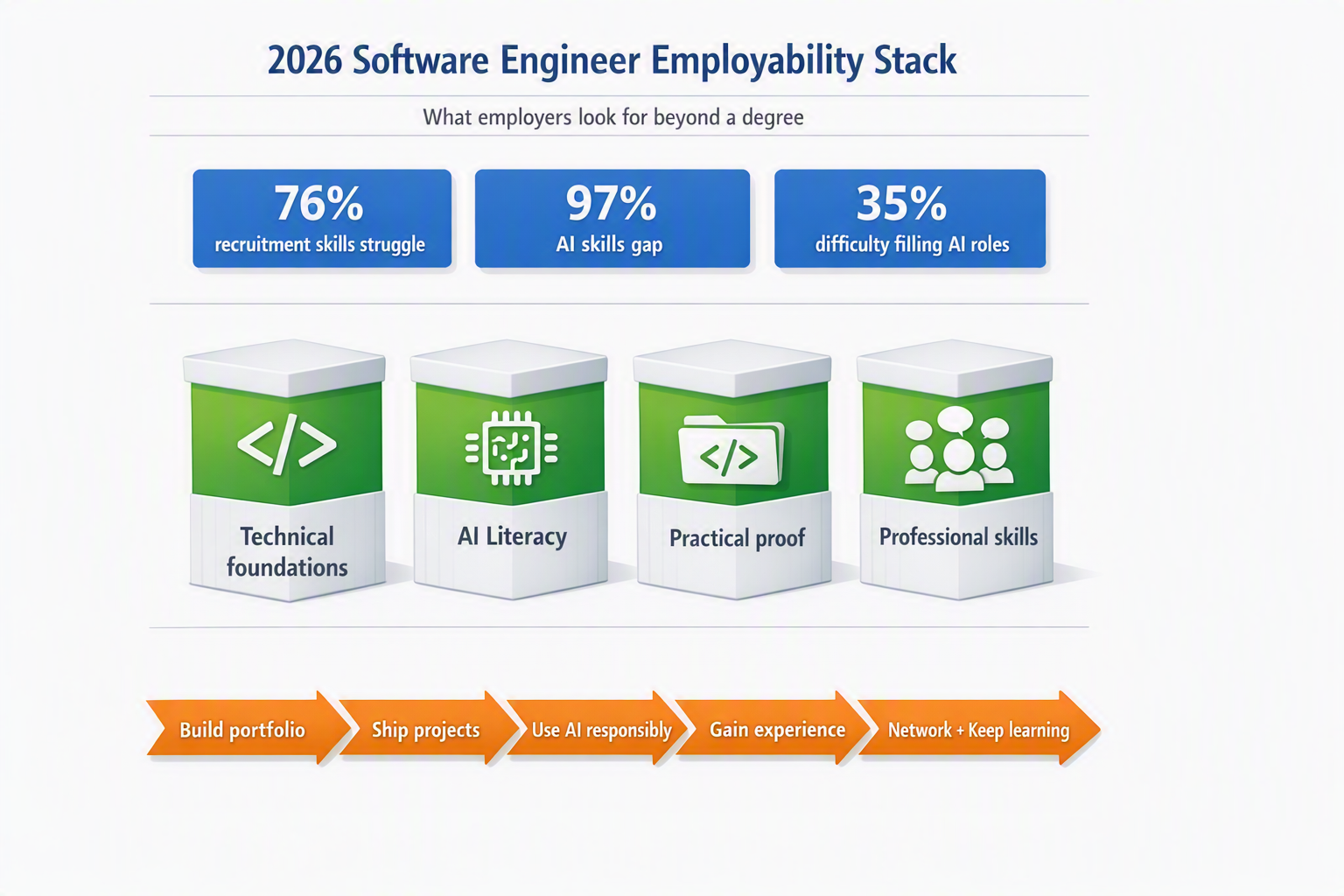
The skills employers need are evolving alongside advances in technology, automation, and AI.
According to the Institution of Engineering and Technology's (IET) UK Engineering and Technology Skills 2025 report, 76% of engineering and technology employers struggle to recruit for certain skills. The report also found that innovative thinking was ranked as the most important capability for business growth over the next five years (42%), followed by technical and engineering skills (39%), and specialist digital skills and knowledge (39%).
Writing code is still important, but employers increasingly value graduates who can solve problems, collaborate with others, and think beyond technical requirements.
The strongest candidates understand both the technical and business impact of their work.
Technical skills that remain in high demand
Some technical skills remain consistently valuable, regardless of how quickly technology evolves.
The IET's research found that automation and cybersecurity were identified as the most important digital skills for future growth (38%), followed by data engineering (34%) and software engineering (33%).
Software development and programming
Strong programming skills remain the foundation of a software engineering career. Employers continue to seek candidates who understand software design principles, testing methodologies, debugging, version control, and agile development practices.
While specific programming languages vary by organisation, employers are generally more interested in your ability to solve problems and build effective software solutions than expertise in one language alone.
Cybersecurity awareness
Cybersecurity is increasingly becoming a responsibility shared across development teams. Understanding secure coding practices, data protection, authentication methods, and vulnerability management can help you demonstrate that you can build robust and resilient applications.
Given that cybersecurity was identified by UK employers as one of the most important digital skills for future growth, it is an area worth developing regardless of your intended specialism.
Automation and DevOps
Automation is playing a growing role in modern software development. Organisations rely on automated testing, deployment pipelines, and infrastructure management to improve efficiency and reliability.
Knowledge of DevOps practices, CI/CD pipelines, and automation tools can help demonstrate that you understand how software is developed and delivered in contemporary technology environments.
Data and cloud technologies
Cloud computing and data-driven decision-making continue to shape software engineering careers.
Building knowledge of cloud platforms, distributed systems, and data engineering concepts can broaden your career opportunities and help align your skill set with the areas UK employers have identified as important for future growth.
The growing role of AI in software engineering
Artificial intelligence is reshaping software development, but it is not replacing software engineers. Instead, it is changing the skills employers expect candidates to possess.
The IET's UK Engineering and Technology Skills 2025 report found that 58% of engineering and technology employers already use AI software or equipment, while a further 23% plan to adopt AI in the future. Among those organisations, the most commonly cited benefits include improved productivity (61%) and enhanced problem-solving (50%).
At the same time, the AI Labour Market Survey 2025 found that 97% of organisations identified at least one AI skills gap, while understanding AI concepts and algorithms remains one of the most significant capability gaps across the sector.
For aspiring software engineers, understanding how AI works is becoming a valuable career advantage.
You do not necessarily need to become an AI specialist. However, employers increasingly value engineers who understand how AI tools can support software development, improve productivity, and enhance problem-solving while recognising their limitations and using them responsibly.
The future belongs to engineers who can use AI effectively while continuing to apply human judgement, creativity, and technical expertise.
Why projects and portfolios matter
One of the biggest challenges employers face when recruiting graduates is assessing whether candidates can apply their skills in practical situations.
The DSIT survey found that organisations continue to experience hiring challenges because candidates often lack work experience and opportunities to demonstrate the commercial application of their knowledge. The report also highlights the value of internships, industry placements, business collaborations, and applied project work in helping graduates develop career-ready skills.
This is why portfolios have become such an important part of the recruitment process.
A strong portfolio helps employers assess what you can do, rather than simply what you have studied.
Examples may include:
- GitHub repositories
- personal coding projects
- open-source contributions
- hackathon participation
- volunteer software development work
- university projects with real-world applications.
A well-documented project that demonstrates technical expertise, problem-solving, and persistence can often have a greater impact than a list of completed modules on a CV.
By showcasing your work publicly, you provide evidence of your capabilities and give employers greater confidence in your ability to contribute in a professional environment.
Essential workplace and professional skills
Technical capability alone is rarely enough to succeed in modern software engineering roles.
The IET report found that innovative thinking was considered even more important for future business growth than technical skills, highlighting the growing importance of professional competencies alongside technical expertise.
Some of the most valuable professional skills include:
Communication
Software engineers regularly work with stakeholders from different backgrounds. Being able to explain technical ideas clearly can improve collaboration and project outcomes.
Teamwork and collaboration
Software development is rarely a solo activity. Employers value individuals who can work effectively within teams, share knowledge, and contribute positively to collaborative environments.
Problem-solving
At its core, software engineering is about solving problems. Employers seek candidates who can analyse challenges critically, explore potential solutions, and make informed decisions.
Adaptability
Technology changes quickly, and employers value people who are willing to keep learning.
Continuous learning
The AI Labour Market Survey found that many organisations rely on ongoing workplace learning and informal training to develop skills. This highlights the importance of viewing professional development as a continuous process rather than something that ends when you graduate.
How to boost your employability while studying
You don't need to wait until graduation to build your employability.
The AI Labour Market Survey highlights the importance of practical experience, industry exposure, and applied learning. Taking proactive steps during your studies can help strengthen your profile before graduation.
You could:
- build and maintain a GitHub portfolio
- complete practical software development projects
- explore AI-assisted development tools and workflows
- contribute to open-source projects
- participate in hackathons or coding competitions
- gain experience through internships, volunteering, or freelance opportunities
- network with professionals across the technology sector
- develop expertise in cloud computing, automation, and cybersecurity.
These experiences can help bridge the gap between academic learning and workplace expectations while providing tangible evidence of your skills and initiative.
Building a future-proof software engineering career
An MSc can provide valuable technical knowledge and help you develop advanced analytical and problem-solving skills. However, becoming an employable software engineer in 2026 requires more than academic achievement alone.
Research from the IET shows that employers continue to prioritise software engineering, cybersecurity, automation, specialist digital knowledge, and innovative thinking. Meanwhile, the UK's AI labour market research highlights the growing importance of practical experience, AI literacy, and continuous professional development.
By combining technical expertise with practical experience, professional skills and AI awareness, you'll be better prepared for the opportunities and challenges of a changing technology sector.
Explore Aston Online's MSc Computer Science
Ready to build the skills employers are looking for? Explore Aston Online's MSc Computer Science and discover how postgraduate study can help support your long-term career ambitions.
References
Institution of Engineering and Technology (IET). (2025). UK Engineering and Technology Skills. Available from: IET UK Engineering and Technology Skills Report
Gardiner & Theobald. (2026). AI Labour Market Survey 2025. Report prepared for the Department for Science, Innovation and Technology (DSIT). Available from: AI Labour Market Survey 2025 Executive Summary
Information was accurate at the time of publication. Industry trends, technologies, and employer requirements may change over time.
'%3e%3cpath%20id='facebook'%20d='M17.9995%209.76563C17.9995%204.7951%2013.97%200.765625%208.99951%200.765625C4.02899%200.765625%20-0.000488281%204.7951%20-0.000488281%209.76563C-0.000488281%2013.9863%202.90543%2017.5279%206.82547%2018.5007V12.516H4.96967V9.76563H6.82547V8.58051C6.82547%205.51727%208.21183%204.09743%2011.2193%204.09743C11.7895%204.09743%2012.7734%204.20939%2013.1759%204.32099V6.81399C12.9635%206.79167%2012.5945%206.78051%2012.1362%206.78051C10.6606%206.78051%2010.0903%207.33959%2010.0903%208.79291V9.76563H13.0301L12.525%2012.516H10.0903V18.6997C14.546%2018.1615%2017.9995%2014.3671%2017.9995%209.76563Z'%20fill='white'/%3e%3c/g%3e%3cdefs%3e%3cclipPath%20id='clip0_1176_4916'%3e%3crect%20width='18'%20height='18'%20fill='white'%20transform='translate(-0.000488281%200.578125)'/%3e%3c/clipPath%3e%3c/defs%3e%3c/svg%3e)

'%3e%3cpath%20id='icon'%20d='M9.00023%200.578125C6.55596%200.578125%206.24921%200.588813%205.2892%200.632501C4.33106%200.676376%203.67705%200.828065%203.1048%201.05063C2.51285%201.28051%202.01072%201.58801%201.51047%202.08845C1.00984%202.58871%200.702334%203.09084%200.471707%203.6826C0.24858%204.25504%200.0967031%204.90923%200.0535776%205.86699C0.0106397%206.82701%20-0.000610352%207.13395%20-0.000610352%209.57822C-0.000610352%2012.0225%200.0102649%2012.3283%200.0537654%2013.2883C0.0978283%2014.2465%200.249517%2014.9005%200.471895%2015.4727C0.70196%2016.0647%201.00946%2016.5668%201.50991%2017.0671C2.00997%2017.5677%202.5121%2017.8759%203.10367%2018.1058C3.6763%2018.3284%204.3305%2018.4801%205.28844%2018.5239C6.24845%2018.5676%206.55502%2018.5783%208.99911%2018.5783C11.4436%2018.5783%2011.7494%2018.5676%2012.7094%2018.5239C13.6675%2018.4801%2014.3223%2018.3284%2014.8949%2018.1058C15.4867%2017.8759%2015.9881%2017.5677%2016.4881%2017.0671C16.9888%2016.5668%2017.2963%2016.0647%2017.5269%2015.4729C17.7481%2014.9005%2017.9%2014.2463%2017.945%2013.2885C17.9881%2012.3285%2017.9994%2012.0225%2017.9994%209.57822C17.9994%207.13395%2017.9881%206.82719%2017.945%205.86718C17.9%204.90905%2017.7481%204.25504%2017.5269%203.68278C17.2963%203.09084%2016.9888%202.58871%2016.4881%202.08845C15.9875%201.58782%2015.4869%201.28032%2014.8944%201.05063C14.3206%200.828065%2013.6662%200.676376%2012.7081%200.632501C11.7481%200.588813%2011.4424%200.578125%208.99742%200.578125H9.00023ZM8.19285%202.20002C8.43248%202.19964%208.69985%202.20002%209.00023%202.20002C11.4033%202.20002%2011.6881%202.20864%2012.637%202.25177C13.5145%202.29189%2013.9908%202.43852%2014.308%202.56171C14.728%202.72484%2015.0275%202.91984%2015.3423%203.23484C15.6573%203.54984%2015.8523%203.84985%2016.0158%204.26985C16.139%204.58673%2016.2858%205.06299%2016.3257%205.9405C16.3689%206.88926%2016.3782%207.17426%2016.3782%209.57616C16.3782%2011.9781%2016.3689%2012.2631%2016.3257%2013.2118C16.2856%2014.0893%2016.139%2014.5656%2016.0158%2014.8825C15.8527%2015.3025%2015.6573%2015.6015%2015.3423%2015.9164C15.0273%2016.2314%2014.7282%2016.4264%2014.308%2016.5895C13.9912%2016.7132%2013.5145%2016.8595%2012.637%2016.8996C11.6883%2016.9427%2011.4033%2016.9521%209.00023%2016.9521C6.59702%2016.9521%206.31221%2016.9427%205.36345%2016.8996C4.48594%2016.8591%204.00968%2016.7125%203.69224%2016.5893C3.27224%2016.4262%202.97223%2016.2312%202.65723%2015.9162C2.34223%2015.6012%202.14722%2015.3019%201.98372%2014.8817C1.86053%2014.5648%201.71372%2014.0886%201.67378%2013.2111C1.63066%2012.2623%201.62203%2011.9773%201.62203%209.57391C1.62203%207.17051%201.63066%206.88701%201.67378%205.93825C1.71391%205.06074%201.86053%204.58448%201.98372%204.26723C2.14685%203.84722%202.34223%203.54722%202.65723%203.23222C2.97223%202.91721%203.27224%202.72221%203.69224%202.55871C4.00949%202.43496%204.48594%202.28871%205.36345%202.24839C6.1937%202.21089%206.51546%202.19964%208.19285%202.19777V2.20002ZM13.8044%203.69441C13.2082%203.69441%2012.7244%204.1776%2012.7244%204.77404C12.7244%205.3703%2013.2082%205.85406%2013.8044%205.85406C14.4007%205.85406%2014.8844%205.3703%2014.8844%204.77404C14.8844%204.17779%2014.4007%203.69403%2013.8044%203.69403V3.69441ZM9.00023%204.9563C6.44777%204.9563%204.37831%207.02576%204.37831%209.57822C4.37831%2012.1307%206.44777%2014.1992%209.00023%2014.1992C11.5527%2014.1992%2013.6214%2012.1307%2013.6214%209.57822C13.6214%207.02576%2011.5527%204.9563%209.00023%204.9563ZM9.00023%206.57819C10.657%206.57819%2012.0003%207.92127%2012.0003%209.57822C12.0003%2011.235%2010.657%2012.5783%209.00023%2012.5783C7.34328%2012.5783%206.0002%2011.235%206.0002%209.57822C6.0002%207.92127%207.34328%206.57819%209.00023%206.57819Z'%20fill='white'/%3e%3c/g%3e%3cdefs%3e%3cclipPath%20id='clip0_1176_4920'%3e%3crect%20width='18.0005'%20height='18'%20fill='white'%20transform='translate(-0.000488281%200.578125)'/%3e%3c/clipPath%3e%3c/defs%3e%3c/svg%3e)




'%3e%3cpath%20d='M12.2%2011.9746L7.55005%207.32461L9.40005%205.47461L15.9%2011.9746L9.40005%2018.4746L7.55005%2016.6246L12.2%2011.9746Z'%20fill='white'/%3e%3c/g%3e%3c/svg%3e)